

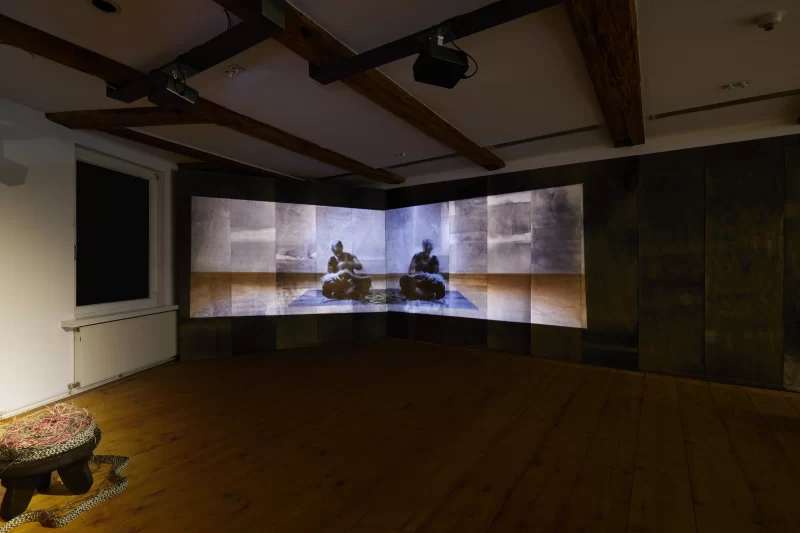
The Open Weave I (2024) is a two-channel video installation that explores intergenerational memory, ritual, and the embodied act of weaving as a means of sustaining relationships across time. It references Letters to…, a video I made in 2016, which was paired with a two-part letter by feminist activist and writer Demere Kitunga, who is also my mother. In her letter, my mother recalls the silent intergenerational transmissions that guided her in childhood and makes a plea for speech: “Talking to you is my attempt to find my tongue…” She returns three times to the image of a single marigold growing on the burial site of her infant sibling. Though ephemeral, the marigold flower remains a vivid memory—it marks the site of an enduring family wound and becomes a metonym for speaking the unspeakable, for holding grief within the fragile yet persistent form of a bloom.
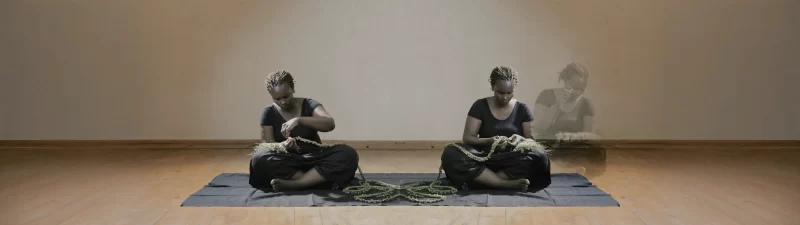
In this work, The Open Weave I, we encounter cross-legged figures weaving plucked flowers into a long, growing chain—an exaggerated version of the floral accessories I was taught to make as a child, worn as crowns, bracelets, or necklaces. Here, the weave extends far beyond its original form. It is both a gesture of continuity and a meditation on connection—between past and present, individual and collective, earthly and spiritual. The mirrored video frames play in tandem, creating a rhythmic interplay of stillness and motion: as one figure moves, the other follows, resume again and again in a recursive loop. This cyclical rhythm recalls the nature of ritual, where repetition becomes a mode of transmission, and learning is embodied through observation and pracice. The act of weaving is thus more than a process of making—it is an embodied way of knowing, a practice of care, and a means of keeping relationships alive even across distances and ruptures.
Interspersed within this act of weaving are frames of hands tending to a barely alive marigold—cupping and gently coaxing it back to life. The image of the marigold here is striking for several reasons: its vivid orange bloom sits atop a gray, withered stem—a zombie flower embodying both death and regeneration. It carries the weight of histories that linger at the edge of disappearance. The act of nurturing it, then, becomes an assertion against forgetting—a conscious refusal against forces of erasure.
[The marigold, or tegete, was introduced to Tanzania, my home country, during German colonial rule, brought through scientific and botanical curiosity that displaced and transplanted hundreds of plant species. Today, it grows rampant in the region. Yet its survival is not reducible to ecological similarities between sites of origin and transplantation alone. As my mother’s text exemplifies, Tanzanians have woven the flower into memory and ritual. For me, the marigold’s survival is not reducible to biology or ecological similarities between the sites of extraction and transplantation alone. It is also kept alive by the stories and rituals that recoup it from its alienation as a colonial specimen and liberate it into relation.]The fragile marigold then, reminds us that even in the face of extraction and displacement, stories and practices can root anew, sustained by those who tend to them. The Open Weave I therefore invites us to reconsider how our bodies, gestures, and environments remain entangled, and how, through acts of making and remembering, we might continue to weave futures that acknowledge and honor the past.
2-Channel video installation on soot paper
2024